29 March 2006

Fear

"I must not fear. Fear is the mindkiller. Fear is the little death that brings total obliteration. I will face my fear. I will permit it to pass over me and through me. And when it has gone past me I will turn to see fear's path. Where the fear has gone there will be nothing. Only I will remain."

—Frank Herbert


[I]f you understand fear—which can only take place when you come directly in contact with it...—then you do something; only then will you find that all fear ceases—we mean all fear, not fear of this kind or of that kind.

—J. Krishnamurti, The Book of Life


They say that it's not the pain that bothers us so much as the fear of the pain. But even then it's not so much the fear as the avoidance of the fear. For a minor example, I used to have a minor phobia about spiders. I would avoid them and stay as far away as possible. Then one day I sat down and just watched some spiders, and they were fascinating, and beautiful. Fine, I will react if one is crawling on me and I don't know how poisonous it is, but otherwise there is nothing to fear.

Before my grandma's funeral, I forgot to pack anything nice to wear, so I went out and found a black taiji tunic embroidered with yellow dragons. My mom freaked out. She was terrified that Grandma's hometown friends would start spreading gossip: "Did you hear what Hazel's granddaughter wore to her funeral?!?" I said, "Great! I'll be immortal." Mom wasn't amused, and she was under enough stress already that I agreed to a compromise (a black Chinese style shirt with a black dragon; apparently it was the bright yellow that was freaking her out). But it's rather ridiculous to allow this sort of fear to rule your life.

Sometimes fear is useful: it tells us it would be a bad idea to go play with the growling bear, for instance. But if it freezes us in place when we should be acting, then it is no longer useful. It's not so much about "facing" the fear but rather "accepting" it. Fine. I'm afraid of "X". I admit that, I explore that feeling, and then I decide if an action is required. Most times, I find that it wasn't "X" I was afraid of, but some idea associated with "X", and then the fear would vanish. And, interestingly, when I'm really in a situation where fear would make sense, I am usually too busy reacting to notice. I remember a few close shaves on the interstate where I had to do some very careful maneuvering. If it had gone badly, I and my passengers might have been killed. But I wasn't thinking of that. I wasn't thinking at all: I was responding. It was only after the fact that I realized how close it had come, and by that time there was no point in fear. It was done.

21 March 2006

Who for Whom

(This is from Thomas Cleary's translation of the Lieh Tzu, included in Tales of Inner Meaning)

Once a man held a huge banquet with a thousand guests. When someone presented a gift of fish and fowl, the host said appreciatively, "Heaven is generous to the poeople indeed, planting cereals and creating fish and fowl for our use." The huge crowd of guests echoed this sentiment.

A youth about twelve years old, however, who had been sitting in the most remote corner of the banquet hall, now came foreward and said to the host, "It is not as you say, sir. All beings in the universe are living creatures on a par with us. No species is higher or lower in rank than another, it's just that they control each other by ifferences in their intelligence and power; they eat each other, but that does not mean they were produced for each other. People take what they can eat and eat it, but does that mean that heaven produced that for people? If so, then since mosquitoes bite skin and tigers and wolves eat flesh, does that not mean that heaven made humans for the mosquitoes and created flesh for tigers and wolves?"

~~~~~~~~~~~~~~~~~~~~~~~~~~~~~~~~~~~~~~~~

One point of major annoyance for me is modern society's assumption that humans are superior to all other creatures. Yes, we can do things that other creatures cannot. We can build machines that emulate much of what other creatures do. But there is so much we cannot do that is done everyday by some other creature without effort. And even those things that we can do are forced. They do not come of themselves, but only after great effort. A bird spreads its wings and flies when it is ready. We have to dig materials out of the earth, build factories, design and plan and plot... and we call ourselves clever and powerful for exerting massive effort to do something that a bird does without effort. *sighs*

18 March 2006

In the Fog

Yesterday, my family and I drove back from Colorado, from my grandma's funeral. I had the last driving shift, and the sun had gone down. Sometime before we made it to the Wyoming/Idaho border, I encountered a thick patch of fog. Then it was gone. Then another patch, and another, each one seemingly thicker than the last. Finally, the whole world was swallowed up in fog. I slowed down enough that I would have at least three seconds to react to anything that came out of the fog. Sometimes this meant 40 mph, sometimes 55 mph, depending on the density of the fog. I had been tired before I started driving, and it would seem that dealing with the fog should increase that tiredness, but it didn't.

Instead, I felt fully alive and awake. I was fully in the moment. I had to be. I had to be ready to react to a slow car ahead of us, or an animal running out from the side. It seemed that the world shrank down to the foggy dome around us, and I was one with that world. In fact, this driving was easier than the driving I'd done in full, clear daylight. Fewer distractions, and more of a need for mindfulness. I admit to feeling relief when we hit the clear patches, but while I was in the fog, the fog was all there was.

I ran across a few appropriate phrases and ideas this morning.

From Thomas Cleary's translation of Vitality, Energy, and Spirit: "Able to reach the point where there is no enjoyment, [sages] find there is nothing they do not enjoy. Since there is nothing they do not enjoy, they reach the pinnacle of enjoyment." When I am in the moment, I enjoy nearly everything I do. When I am not, when I am thinking of all the other things I would rather be doing, then everything becomes miserable.

From Larry Rosenberg's Breath by Breath come the ideas of vittaka: bringing attention to an object with both energy and mindfulness, vicara: maintaining interest in the object, piti: enlivened energy or anticipation, and sukha: the pleasure of peace and calm. These are ideas that come from the Buddhist practice of vipassana meditation. The first thing I found of interest is that I have experienced all of these states at various times. First in yoga practice, later in taiji and meditation. But they all came into play as I drove through the fog. I had to focus on the road ahead of me, and keep all my senses alert for any change. When something did change, I felt excitement/anticipation/adrenaline, and used that to heighten my awareness. Then when I found that I could meet all the challenges, a sense of peace and rightness descended over me. I did not fight the fog. I accepted and embraced it, and in doing so, I was able to meet it.

13 March 2006

Shattered

If there's a trigram in the I-Ching for "shattered," then it aptly describes most of my last week. On Monday, the front left window of my car literally shattered while I was on the interstate. On Thursday, I found that my arrow had indeed hit its mark, but had not had the hoped for effect. On Friday, my last surviving grandparent died. So I'm a bit confused right now, in that I'm "supposed" to be upset, or angry, or...something. Yet, in this moment, I am content. Happy, even. I'm not entirely sure why, but I suspect it has something to do with "living in the moment."

I can make myself become upset. I can go back in my mind to Friday morning. I had slept on the couch in Grandma's basement, and around 6:30 my mom came down and turned on the light. I was awake enough to mumble "Was that really necessary?" I'm not sure she heard me. "...I think she's gone..." was all she said. That woke me up. Grandma went off dialysis on Monday, and she'd been fading fast ever since. I went upstairs and slowly approached Grandma's room. She was still, frozen in time. One hand half-clutched the rail of the hospital bed they'd brought for her the day before. One toe stuck out between the bars. Her mouth was open...eyes closed. I didn't really need to check for a pulse, but I did. "She's cold," I said.

When I go back to that moment in my mind, I feel the pain. Yet as soon as I bring my mind away from that moment, the pain goes with it. When I go back to the moment when I learned what effect my arrow had, there is pain. Yet in this moment, there is only piece. The past is gone. Only this moment remains. And in this moment, my grandma no longer suffers. In this moment, there is no more waiting. In this moment, I am at peace.

And, in the human way of things, I feel an echo of guilt that I am not dwelling on the past, not wallowing in the pain. But it is only an echo, and is easy enough to recognize and ignore. And the window that shattered on Monday...it got replaced on Tuesday. No one can replace my grandma, of course, but eventually that empty place will fill again.

05 March 2006

Reality

(Note: This post is Babylon 5 inspired. The Vorlons ask "Who are you?" The Shadows ask "What do you want?")

There was a time when most of my actions were dictated by what I thought I was "supposed" to do. I'm "supposed" to get upset over things. I'm "supposed" to try and fit in. I'm "supposed" to get good grades. I'm "supposed" to pick a hard major, because I got good grades. It wasn't until I burned myself out doing a double major in four years that I really figured out that I wasn't "supposed" to do anything. I was just "supposed" to be.

There's a danger in that realization, though: the danger of then doing nothing at all. But at the time, I had spent so much time on what I thought I was supposed to be doing that I had no clue what it was that I actually wanted. I think that was my very first meditational experience, sitting down in a quiet place and asking myself, "What do you want?" I had no clue. The usual things that people list, like money, a job, a family, meant nothing to me. I think I spent a year asking that question before I finally decided that since I didn't know what I wanted for me, I'd just start sending out positive thoughts to the rest of the world.

Eventually, I answered the question, "What do you want?" with "I want to be me." It was a good, satisfying answer that brought its own question: "Who am I?" In college, I had defined myself in terms of my mood and my major, largely. And in terms of what I wasn't. I wasn't a Methodist any more. I wasn't a high school student. After a while, I wasn't a teenager. I wasn't really interested in research (so why the devil was I majoring in physics? because I was "supposed" to). I didn't have much else when I started asking "Who am I?" again. The most useful answer to the question turns out to be "I am me." But at least I have some positives to add now. I am a Taoist. I am a taiji player. I am a teacher. I am a writer. But those are what I am, not who I am.

The thing is, it's impossible to be who you are while you're busy being someone else. And whenever you do what you're "supposed" to do, you are being someone else. You are living up to someone else's expectations, fulfilling someone else's dreams. I don't mean to suggest that people skip out on obligations to others, but that we honor those obligations because we want to, not because we are supposed to. And if we find we have obligations that we do not want to fulfill, perhaps it is time to start asking "Who am I?" and "What do I want?"

02 March 2006

Thoughts on Freedom

(Note: I will try to update more often... I just needed time to think some things through.)

Without a rope, people bind themselves."

When based on compassion, this can be a good thing. Though I may feel anger at someone, I do not loose that anger. Though, at times, violent thoughts may arise, I do not act on them (except constructively, by finding some useful and productive way to express such thoughts). Such binding is internal, not external. I know that I could do something, but I do not care for the end results, so I do not.

When based on fear, or craving, the binding is harmful. It traps us. We get caught in a web of "ifs" and "maybes" and fear of the unknown stops us from acting. But the unknown is all around us. I could die on the way to work this morning. I could be hit by a meteor while I sleep, or come into contact with a rare poison, or be attacked by a dog. There are more things unknown than known, yet these insidious mental "what-ifs" trap us, prevent us from acting.

I recently broke free from such a trap, and loosed the arrow that I had held onto for so long that my arm had begun to shake. I do not know whether it has hit its mark yet, nor do I know what effect it will have when it does. Yet in loosing the arrow I have freed myself. Oh, the "what-ifs" still rise up in my mind, but it is easier to let them go now. It may have been a foolish thing to do, yet it needed to be done.

arrow now in flight—
free only in the falling—
frees me while I wait

05 February 2006

Frustration

*sigh* The more I read of both atheist and religious blogs, the more I think they miss the point entirely.

Asking me whether or not I believe in Tao is like asking me whether or not I believe in the table sitting in front of me. The question is redundant and idiotic. Asking me whether Tao exists is equally idiotic. How might I respond? Verbally, I would likely say "Mu." In person, I would probably pick up a glass and drop it on the floor. Or take a match and set a book on fire. Or wave a flag in the air. Or hit the questioner with a stick. If the questioner doesn’t understand, the question was doubly idiotic.

Yet I see people try to answer the question of whether or not God exists, and they actually answer with yes or no. If they actually understood the question, such an answer would be impossible!

There are several koans along this theme already, so this is hardly original, but I haven’t seen this precise version: The teacher spoke to the monks, saying, "Do you believe in the gods? If you answer yes, then the gods do not exist. If you answer no, then they do. How, then, will you answer?"

Another related quote/koan: "When we understand, there we sit while yes and no chase each other around the circumference."

21 January 2006

The Iron Flute

About a week ago, I finished Nyogen Senzaki's The Iron Flute. It is a collection of 100 Zen koans, with commentary, and I highly recommend it to anyone with an interest in either Taoism or Zen. Back in the archives, I've posted many of my favorites, so I won't post any here.

Each koan has commentary with it, and the commentary is iself a koan in most cases. However, my favorite part of the commentary is that it has been built onto over the years. Genro, Fugai and Nyogen have all added comments (Nyogen's being the most recent), and they weave together like a conversation, or sometimes an argument, clarifiying and confusing all at the same time. There are cases where the commentary opened my eyes to a meaning I hadn't seen before, and other cases where I thought I understood until I read the commentary.

One final thought. This is not a book to sit down and read all at once. Perhaps some people would get something out of it that way, but I sure wouldn't. I read this book slowly. First I tried one koan a day, then I decided that wasn't enough. I would read a koan one day, and reread it the next. Sometimes I would reread it the third day as well, but usually I moved on. So I've been working on this book since last August. It was well-worth it, and I'm sure I'll come back and reread them all again at some point.

17 January 2006

Books

In 1934, Krishnamurtie said, "Why do you want to be students of books instead of students of life? Find out what is true and false in your environment with all its oppressions and its cruelties, and then you will find out what is true." Repeatedly he pointed out that the "book of life," which is ever changing with a vitality that cannot be held in thought, was the only one worth "reading," all others being filled with secondhand information. "The story of mankind is in you, the vast experience, the deep-rooted fears, anxieties, sorrow, pleasure and all the beliefs that man has accumulated throughout the millennia. You are that book."
...
"Truth cannot be accumulated. What is accumulated is always being destroyed; it withers away. Truth can never wither because it can only be found from moment to moment in every thought, in every relationship, in every word, in every gesture, in a smile, in tears."

—from the introduction to The Book of Life by Krishnamurti


I'm sure Krishnamurti appreciated the irony of being a writer of books... :-) However insightful, however erudite, the words of another belong to another. Only your own experiences belong to you. Words may point you in a useful direction, or give you some idea what is possible, but the next step is always yours.

I like Krishnamurti's take on truth. It is not Absolute Truth that is frozen in a rictus of death; it is Living Truth. It stays the same by constantly changing, in each and every moment. "Nothing is trivial," as Brandon Lee's character said in The Crow. All the little things together form the truth in each moment, and in so doing are no longer little.

13 January 2006

From the Chuang Tzu

The way has reality and truth; it has no construction or form. It can be given but not taken; it can be attained but not seen. It is based on itself, rooted in itself; it has always been there, even before the existence of heaven and earth. It spiritualizes ghosts and gods, gives birth to heaven and earth. It is ahead of the absolute pole, without being high; it is beyond all limits without being deep. It was born before the universe and yet is not ancient; it is senior to antiquity, and yet is not old.
...
"What kills the living does not die; what gives birth to the living is not born. What it is brings on everything and sends off everything, breaks everything down and makes everything. Its name is peace from agitation. Peace from agitation is attained only after agitation."

—from The Essential Tao, trans. Thomas Cleary


The "absolute pole" most likely refers to the North Star, which seems to stay fixed while all other stars rotate around it. It is considered best to emulate that star, to attain a place where you do nothing and yet everything is done. The Way cannot be old, since it is newborn in each and every moment. It cannot be young, since it has always existed. In other words, labels are useless. :-)

For the second paragraph, consider this Zen koan: "What is your original face before you were born?"

03 January 2006

Gods?

On Pharyngula, I just ran across this quote from Richard Dawkins: "We are all atheists about most of the gods that humanity has ever believed in." I've come across similar claims on other atheist blogs recently, and I find that "all" is inaccurate. I know of at least one exception: me.

First, I don't find the concept of "gods" all that useful. It is certainly true that they exist in the mind, i.e. in the same sense that Middle Earth and Hogwart's exist. For me, that is enough to grant them at least some reality. Any particular god has exactly as much power over a person as that person grants in his/her mind. That is, gods are subjective phenomena: their attributes vary depending on the person perceiving them. Any god held to have specific characteristics falls into this "subjective" category for me. Is such a god useful? I would answer that it depends on the person doing the believing.

The Tao is different. It embodies all characteristics, and none. I would also include the Sufi experience of God in the non-characteristic category based on my admittedly brief readings of Sufi texts. Likewise, I would include the direct experience of the Divine reported by mystics of all sorts. But as soon as you start trying to label and define any god, you have limited it, separated it. It is no longer the Ultimate, but a subset thereof.

02 January 2006

New Year, New Calendar


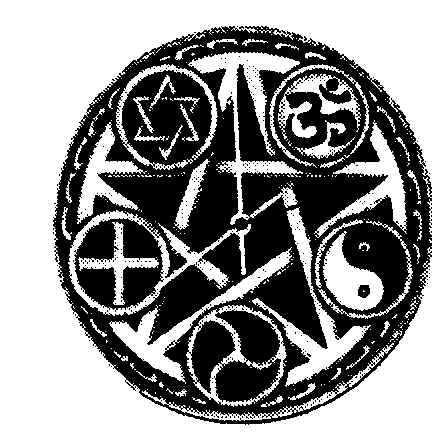
Well, I didn't get another Daily Zen calendar this year. This one is called "Wisdom of the East." I'd had the Daily Zen calendar two years in a row, and there were quite a few repeats so I tried something new. The saying above seems nicely applicable. Now, if I only knew where those symbols came from. ;-)

ADDENDUM:
Found an online Symbol Dictionary, but so far I've only found one of the symbols. Ah well.

The symbol in the top left, that looks like the Greek letter psi with two lines through the stem, stands for magentism or magnesium.

The background for the one in the top right might be a variation of a sun-symbol (four points enclosed in a circle), but I haven't found it exactly.

31 December 2005

A book on Auras and Chakras

For as long as I can remember, I've associated colors with nearly everything, especially sound. This summer I realized I also associate colors with people. I figure this is another aspect of synesthesia, and I suspect it may be a way of encoding "extra" information that the brain has no other way to process. So I went looking for a book that might help me figure things out. Most of them were useless. At least three-quarters were along the lines of: "Open up your Aura and (Become Rich/Find a Mate/Cure Cancer/etc.)" A few were sort of beginner's guides that had little more info than I had already found on the internet. Most of the rest were interdisciplinary, so they might be tied in with crystal healing or divination or some other New Agey thing. I finally found one that actually looked useful: Your Aura & Your Chakras: The Owner's Manual, by Karla McLaren.

I like this book. Especially since all she would need to do to move it from "New Age" to "Self Help" is call her exercises "Positive Visualizations" instead of Aura/Chakra work: i.e. there is little obvious nonsense. She has a no-nonsense, down to earth style that is very nearly Taoist. She emphasizes balance and calls most New Age practices idiotic because they tend to unbalance people. Some of her claims seem a bit overboard to me (she cured a schizophrenic?), but those were parts of minor anecdotes and not the focus of the book.

The focus is on energy exercises/visualizations. Grounding. Clearing stale energy out. Defining and separating the chakras. She gives very specific instructions. And I found that most of what she said agreed with things I'd already experienced. I am aware of the energy centers at the sites called "chakras." In taiji, we generally only work with 3 of them (Root, Heart, Third-Eye), and I suspect that neglecting the others is not good.

Perhaps my favorite part of this book is her manner in dealing with this stuff. At one point, she tells readers not to get cocky just because they know something about the aura and others don't. Why? Some people keep their auras balanced all on their own and never need to worry about fixing anything.

At any rate, I would highly recommend this book to anyone looking for a practical guide to auras, etc.

28 December 2005

Yin and Yang

There is neither heaven nor earth,
Only snow,
Falling incessantly.

—Hashing, 27 Dec. Daily Zen calendar


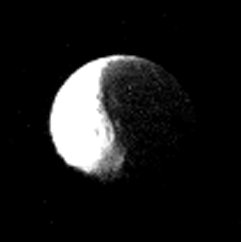
For no obvious reason, I went hunting for yin-yang images this morning. I found some interesting things, as well as some very odd ones. First off, the source of the symbol is the apparent path of the sun through the year. This I had seen before. It is also known as the taiji symbol (or taiji-du, various spellings). Taiji means "supreme ultimate" and it refers to the uppermost support beam in the roof of a house. As the sun moves through the sky, light and shadow switch positions on the slopes of the roof.

Now, some of the more interesting images that I found:
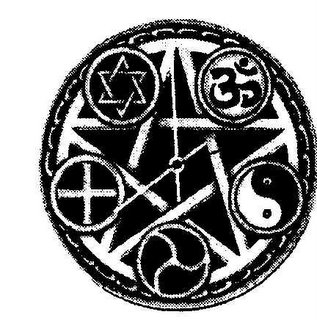
This one comes from a rather hysterical Christian analysis of yin and yang (link is further down). I rather like the confluence of major symbols in it.
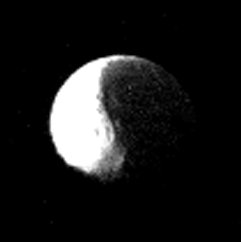

According to the site where I found this, this is an actual picture taken by one of the Voyager probes. Mozilla crashed on me and I lost the link, though.


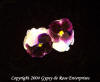
This one is available for purchase as a print (but I would again have to hunt for the link; also lost when Mozilla crashed). I love the way the symbol shows up all over the place in nature.


The last image I'm just going to link to rather than post. It is a 3D stereogram from something called VRillusions. For those who have trouble with stereograms, use the dots above the picture as a guide. Cross your eyes until you get the two dots right on top of each other in the center of your field of vision (you will be "seeing" three dots at this point). Then the 3D image should be visible. Any more, I actually find the guide more distracting than helpful, but that was not always so.


Anyway, the hysterical Christian article got on my nerves, so I'm going to deconstruct it. There is so much wrong with this that I don't even know where to begin. But with all the author's "research", he doesn't even mention the link to the path of the sun, and it sounds like he takes any statement in any book that even mentions "yin/yang" as gospel truth about it. Let's see...

First, something he gets right (by quoting it from another book): "The philosophy of T'ai Chi Ch'uan is rooted in Taoism, which advocates natural effort, and in the I Ching, or Book of Changes. The movements and inner teachings are derived from the complementary relationship between Yin and Yang, two fundamental forces that create and harmonise the Universe by their interaction." He does not mention that "distinguishing full and empty" is what makes taiji one of the most effective martial arts, but he probably didn't bother to research practical applications. He also confuses "palmistry" (a Western art) and "reflexology." Reflexology is about the links of the energy meridians to other parts of the body (usually hands and feet). I've been told of studies of advanced meditators who did energy circulation while hooked up to electrical monitors. There was a measurable flow of electricity right along the meridians described by the Chinese several thousand years ago. The meridians are real (I would like to track that study down, though). I think, though, that reflexology techniques will not work very well in someone whose meridians are blocked.

Most of the rest of the article is completely irrelevant. He confuses Gnostic dualism with yin/yang non-dualism. He insists that the yin/yang has extreme sexual connotations (the Chinese would laugh: the fact that he sees only the sexual implications tells us a great deal about where his mind is). Yin/yang says there must be a balance. Extremism of any flavor indicates imbalance. This includes extreme obsessession with sex as well as the extreme of celibacy. He misses this, and it's probably the most important point. After a great deal more ranting about pagan uses of the symbol (pagans use it! It must be evil! I'm guessing he condemns Christians who dare to put a five-pointed star on their tree as well), we finally get to something relevant to yin/yang.

The yin/yang symbol is quite appropriate today for humanists, New Agers, witches, Satanists, etc. As Michael Tierra, a proponent of the yin/yang theory, states: "The Yin/Yang theory is a teaching method and does not define anything absolute.'' There are seven laws concerning the yin/yang, one of which is: "2. Everything changes."

This is an important item to notice. The idea that "everything changes" does not agree with the Bible. There we find that Jesus Christ is the same yesterday, today, and forever (Hebrews 1 3:8). He doesn't change. James 1:17 also states: "Every good gift and every perfect gift is from above, and cometh down from the Father of lights, with whom is no variableness, neither shadow of turning." Malachi 3:6 tells us: "I am the Lord, I CHANGE NOT."

Another law is: "3. All antagonisms are complementary.'' Again, this is contradictory to Scriptures. This would make Jesus and Satan complementary to each other! What blasphemy!


Well, if God and Christ never change, then they are both dead, for only the dead never change. But that is not what I see in the Bible. God created something. That was a change. Christ came, and the God of the New Testament is clearly different from the God of the Old Testament. That was a change. And, according to Christian doctrine, without Satan to tempt Adam and Eve to eat of the fruit of the tree of knowledge, there would have been no need for Christ. How can they not be complementary?

And how about, "'The extreme of any condition will produce signs of the opposite.'' Again applying this to Christ would mean that because He is the extreme in goodness, mercy, compassion, etc., that He will produce signs of hate, injustice, unconcern,etc." One word: Crusades. Argue all that you want that the Crusades were unChristian, but they were inspired by Christian doctrine nonetheless. Also, "'8. Nothing is solely Yin or Yang; everything involves polarity.'' This is stating that nothing is entirely good or entirely evil. This again contradicts the Scripture for in Habbakkuk 1:13 we find that God is 'of purer eyes than to behold evil and canst not look on iniquity.' The Bible also tells us that there is no truth in Satan (John 8:44). Obviously, the yin/yang theory is not consistent with God's Word." So all the genocides and mass murders in the Old Testament were "pure" and "good"... Also, how does God's inability to look on iniquity square with the idea that God sees and knows all? If he can't look at iniquity, he must be missing an awful lot. And Satan's most potent weapon has always been pure and simple truth (used in a negative way, to be sure, but true nonetheless).

Some final thoughts: the yin/yang symbol is ancient. By only going to modern sources and uses, this author completely missed the mark. You want to know about yin and yang? Go to the ancient Chinese texts. Better yet, look out your door and watch the sun move across the sky, watch the seasons change, watch the moon go through its cycle. Everything changes. This is a fact of life on Earth. To say that God does not change is to declare that God is dead. That-which-is must change to stay the same, moment to moment, eon to eon.

25 December 2005

My take on Christmas (2005)

So…what does Christmas mean to me, a Taoist who stopped labeling herself as a Christian more than a decade ago? To be honest, it’s a question that’s been puzzling me ever since. The Christmas I spent as an atheist was…quite miserable, not to mention confusing. Part of me reacted to the symbology around me while part of me felt disgust, and all of me felt isolated and alienated. However, it was just as confusing after realizing that I believed in something beyond myself, but wasn’t willing to identify that something as the Christian God.

For convenience, I buried myself in pagan symbolism for a while. And, honestly, I still find that more appealing than most Christian symbology. But the pagan rituals and ceremonies… *sighs* I’m just not a ritualistic person, really. And the pagan gods… I see them as constructs of the mind that exist in direct relation to the amount of belief in them. They are useful archetypes and can result in beautiful stories, but they are not the power in the universe. Human awareness and consciousness are more powerful than the ancient gods. And to newly aware humans, the Solstice must have been a powerful symbol: as the nights grew longer and longer, it must have seemed that they might continue getting longer until there was no more day… then came the Solstice, trapping the Sun for three days, and the nights began getting shorter and shorter… And so light had won against darkness for another year, until Midsummer when the darkness would start to gain again.

So I guess I see Christmas as honoring one portion of the neverending cycle of yin and yang. As soon as yin reaches its strongest point, it begins turning to yang, and in that moment of change, there is an instant of pure yang energy. In fact, this happens in every moment, in every breath, in every sunrise…yet it seems appropriate to recognize the yearly progression. We shouldn’t forget the other piece of the cycle, at Midsummer, when yang reaches its strongest point and begins turning to yin. It’s strange, but the Christ-story would fit better at Midsummer than at Winter Solstice. Why? Because the God of the Old Testament is pure and complete yang. No yin at all. Christ had to come to balance that out, to put the yin back into God. To bring balance. Hmmm… by that reckoning, Christ’s coming made God whole. I find that fitting, though I’m sure that thought gives most Christians the screaming heebie-jeebies.

Note: This is where my thoughts on Christmas took me this year. I'd be surprised if they haven't changed some by next Christmas.

Plain potatoes

Zen does not confuse spirituality with thinking about God while one is peeling potatoes. Zen spirituality is just to peel the potatoes.

—Alan Watts, 25 Dec. Daily Zen Calendar


Thinking is not experiencing.

21 December 2005

If you meet the Buddha, kill the Buddha

After [his master's death], Ta-hui gathered all the [master's] publications together in front of the temple and made a bonfire of them. What the teacher builds in shape must be destroyed by the disciples in order to keep the teaching from becoming an empty shell. Western philosophers create their own theory then followers continue to repair the outer structure until it no longer resembles the original. In Zen we say, "Kill Buddha and the patriarchs; only then can you give them eternal life."

—from The Iron Flute by Nyogen Senzaki


No dogma. No tradition. Each generation finds the truth anew, unchanged yet unlike that of the previous generation.

14 December 2005

The Nature of Strength

The only condition for allowing your internal energy to develop, grow, and become strong is that you must relax yourself and yield to the universe. When you become soft and pliable, your internal energy will gradually begin to develop and accumulate. Eventually you will have the ability to become extremely hard and strong, when it is necessary to do so. To make metal into the hardest steel, you must heat the metal, make it as soft and pliable as liquid, and then refine it into the hardest steel.

—Waysun Liao's commentary on the T'ai Chi Classics


This is one of the seemingly paradoxical things about taiji. The kind of strength most people think of as "strength" is only good against those who are weaker in that kind of strength. Do you have strong muscles? Eventually you'll run into someone who has stronger muscles, or you'll grow old and the muscles will fade. Taiji's strength is something else entirely. It is the strength of bamboo in the hurricane, of pine trees laden with snow, of the wind against your face and the water on the rocks. The Tao te Ching observes that water is the softest of all things, yet it can wear down the rock, which is one of the hardest of all things. So it is with the strength of taiji. Relax, accept the force coming at you, and redirect it. The strength of song, alert relaxation, cannot be overcome. The harder you push on it, the stronger it becomes. And as soon as you stop pushing, it's as if there's nothing there. This is true strength and power. All else is illusion and tomfoolery.

Which reminds me... The taiji motto could easily be "Resistance is Futile." :-) When you resist, you are giving power to your opponent, giving him something to push against. When you accept the force directed at you, you can do anything with it (well, anything if you truly accept it and are truly relaxed; I am not yet able to do this consistently).

12 December 2005

More from the Chuang Tzu

When a way is illustrious, it does not guide;
Illustrious, fancy, glowing... it no longer guides, but forces you along and distracts you from what's important.
when humanitarianism is fixated, it is not constructive;
Nothing can be accomplished when you are obsessed with one way of doing things, one way of being right, one way of being.
when honesty is puritanical, it is not trusted;
No one is trusted less than one who can truthfully claim she's never told a lie.
when bravery is vicious, it does not succeed.
Viciousness only distracts from the task at hand.

07 December 2005

Beginninglessness

There is a beginning, there is never beginning to have a beginning, there is never beginning to never begin to have a beginning. There is existence, there is nonexistence. There is never beginning the existence of nonexistence, there is never beginning never beginning the existence of nonexistence. Suddenly there are existence and nonexistence, but we don't know if existence or nonexistence actually exist or not.

Now I have said something, but I don't know if what I have said actually says anything or not.

—from the Chuang Tzu, trans. Thomas Cleary


*grins* I finally started reading the Chuang Tzu, and I'm quite enjoying it. The link in the sidebar is to a different translation. So far I like the Thomas Cleary translation better, but it's always nice to be able to compare. One odd thing: the on-line version has numbered chapters and verses, and the Thomas Cleary version does not.